
What Formula Exclusivity Actually Costs a Haircare Line
Formula ownership is not a price; it is a stack of prices. Development, exclusivity, tooling, registration, documentation and the quiet cost of rebuilding anything the brand does not hold all land in different lines of the budget, and only some of those lines appear in the quotation. For a haircare line, the arithmetic is easier to manage once the layers are separated — because the layer the brand controls usually determines the per-unit cost, and the layer it forgets usually becomes a surprise.
Key takeaways
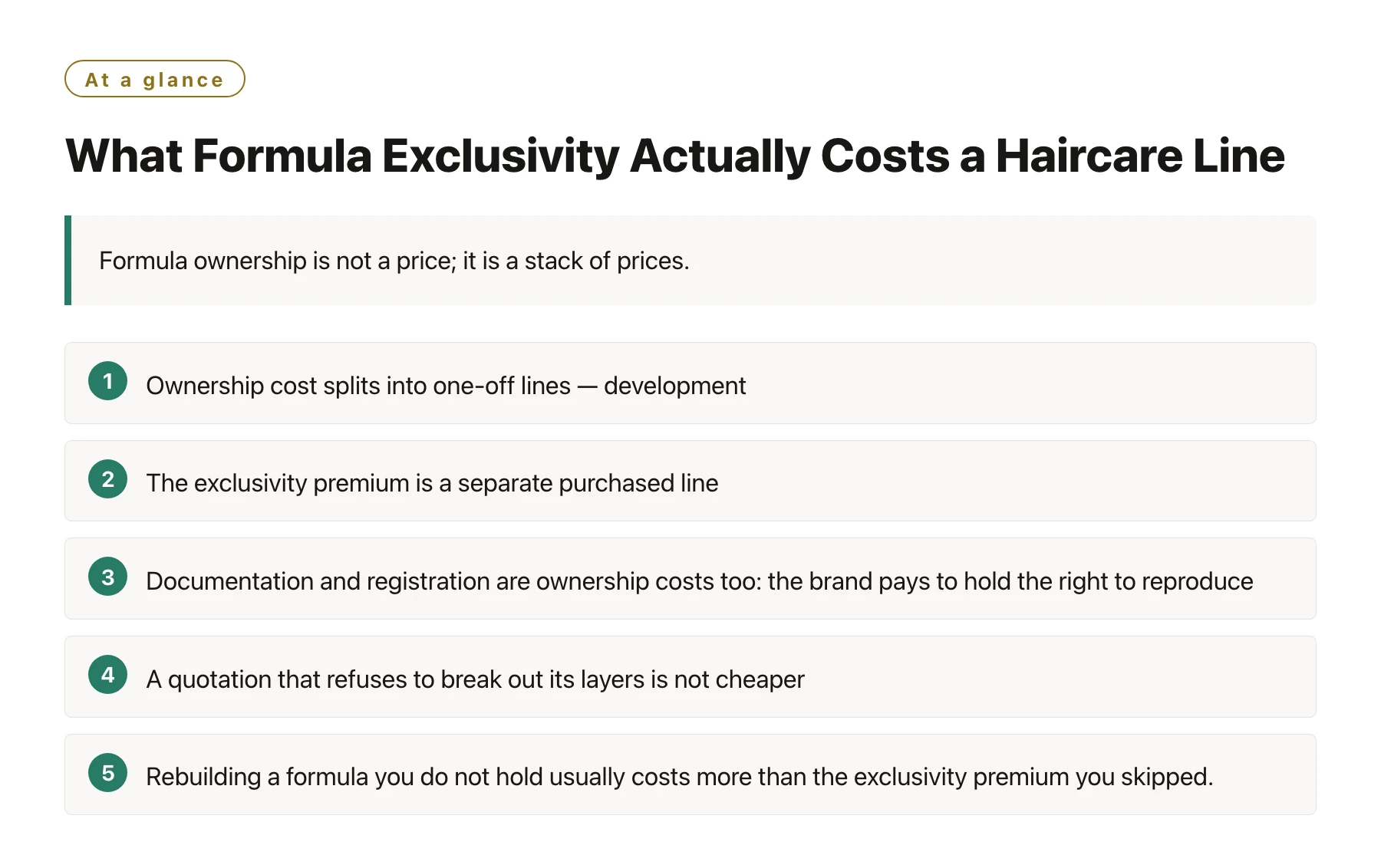
- Ownership cost splits into one-off lines — development, exclusivity, tooling, registration — and per-unit lines that only show up in repeat production.
- The exclusivity premium is a separate purchased line, not a margin hidden inside the concentrate price.
- Documentation and registration are ownership costs too: the brand pays to hold the right to reproduce, defend and sell its product.
- A quotation that refuses to break out its layers is not cheaper; it is simply not comparable.
- Rebuilding a formula you do not hold usually costs more than the exclusivity premium you skipped.
Ask three suppliers to quote the same haircare project and you will get three numbers that cannot be compared, because each one draws the line between one-off and per-unit costs in a different place. One supplier hides development inside the concentrate price; another itemises it; a third leaves registration and documentation out entirely.
The breakdown below follows the order in which money is actually committed, from the laboratory trial to the first carton, and marks which layers a brand controls and which it usually forgets.
Two kinds of cost, and why mixing them ruins the comparison
One-off costs are paid once and then sit in the project file: briefing and development, exclusivity, tooling, registration and the documentation pack. Volume costs repeat with every unit: concentrate, base, packaging, filling and decoration.
Mixing the two produces the familiar situation where a supplier looks cheap at five thousand units and expensive at fifty thousand. That is not deception; it is a different split between fixed and variable cost. Ask for the categories separately and the comparison becomes arithmetic instead of impression.
The ownership cost layers
| Layer | What it buys | One-off or per unit |
|---|---|---|
| Development | A concentrate built to your haircare brief | Mostly one-off |
| Exclusivity | The guarantee that the starting point is not re-offered | One-off or renewable |
| Tooling and moulds | Packaging that belongs to the brand | One-off |
| Registration | Legal protection for the design and the name | One-off, renewable |
| Documentation pack | Batch record, stability file, certificates, ingredient declarations | One-off per product |
| Concentrate and base | The recurring chemistry of the product | Per unit |
| Filling and decoration | Reproducing the pack at volume | Per unit |
The one-off lines are where ownership is bought; the per-unit lines are where it is paid for. A brand that only negotiates the per-unit price is negotiating the second half of the bill.
The lines that usually hide
What the quotation leaves out
Artwork adaptation, translation, market-specific labelling and the tests a destination market requires beyond the supplier's standard panel are frequent omissions, as is the split of who pays for a failed trial. In the EU the framework places the compliance duties on the party that puts the cosmetic on the market, including the safety assessment and the product information file, and that cost needs a named owner before the quote is accepted [1].
What a skipped exclusivity costs later
The rebuild is the expensive version of the same product. If the brand does not hold the concentrate or the base, moving to a second factory means paying for development again — new perfumer, new rounds, new approvals. The exclusivity premium you skipped is usually a fraction of that second development.
Registration as a line item
Industrial designs can be registered through national offices or through the international route administered by WIPO [2]. The filing fees are small, but they are a line in the budget, and they only protect the brand if the brand holds the registration.
Before any deposit, rewrite the quotation as two columns — one-off and per unit — and mark every cell the supplier has not explicitly confirmed. The blank cells are the budget.
Making two quotes comparable
Send the identical brief to each supplier and ask each to answer the same layer list. The numbers will still differ; the difference will finally mean something. Read the stated scope on the official Xuelei website before comparing, because a manufacturer that publishes its service list is easier to hold to it.
Understand which route you are pricing. In a white label fragrance manufacturing arrangement the development line largely disappears — you adapt an existing product — and the per-unit line dominates, which suits a quick launch. In a custom development the one-off lines dominate, which suits a signature scent. Both are legitimate; they are different products with different cost shapes.
A manufacturer with a long operating history has libraries of developed bases and accords, which is why its development line tends to sit differently in the quote. Xuelei's history tells you how long the company has been manufacturing — it states 31 years — and that kind of context explains a quotation as often as it justifies one.
Sources
- European Commission: Cosmetics in the EU —— The European Commission's overview of EU cosmetics rules, including the responsible person, product information file and safety report requirements.
- WIPO — World Intellectual Property Organization —— The UN agency for intellectual property; resources on industrial design and patent protection relevant to product and packaging design.
Frequently asked questions
Is exclusivity cheaper on an ODM base than on a custom formula?
Usually, because the starting point already exists: the manufacturer prices a hold on an existing base rather than the development of a new one. The premium varies with the category, geography and duration of the clause — ask for it as a separate line either way.
What if my budget only allows per-unit pricing for now?
That is a legitimate test-launch strategy: pay per unit, skip exclusivity, and record the decision. The risk is that a successful launch reprices the clause later, when the manufacturer knows the line works.
Who should pay for registration?
The brand pays and the brand holds. Registration protects the packaging and the name; if the supplier pays and holds, the protection belongs to the supplier. The amounts are small; the ownership is not.
How much of the quotation should be one-off?
There is no universal split — it depends on whether you are adapting an existing base or commissioning development. The useful question is not the proportion but the list: every one-off line should have a name, a price and an owner.
Can I negotiate exclusivity after launch?
Yes, but the price will reflect the proof of demand. The layer-by-layer view makes the late negotiation easier to evaluate, because you can see what the exclusivity premium covers and what it does not.
Çeviriniz 60 saniyede fiyatlanır, aynı gün kapınızda.
Noter tasdik, apostil ve konsolosluk onayı tek platformda. 81 dilde, 7/24.