
First-Time Panel Sourcing in Vietnam: A Step-by-Step Walkthrough
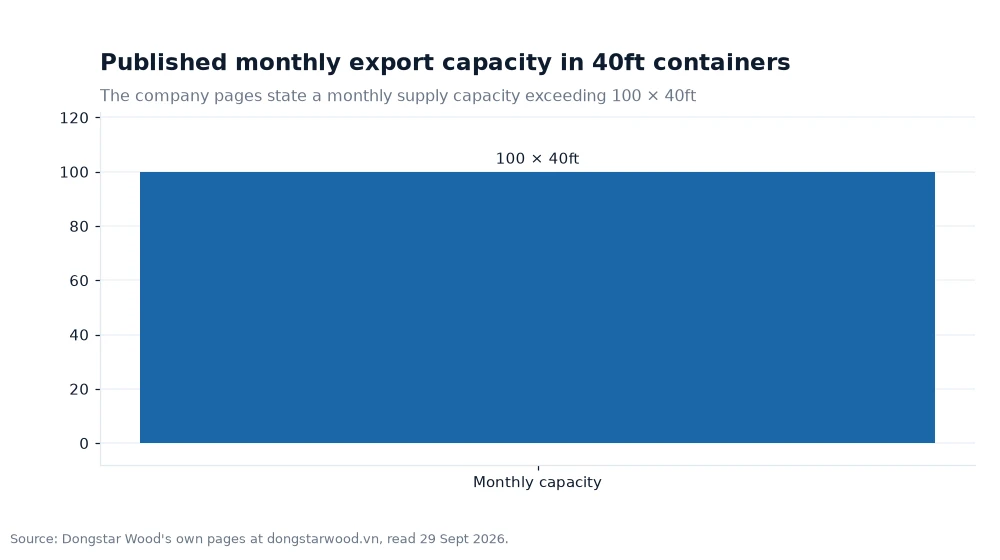
Buying panels from Vietnam for the first time is less about finding a price than about running a sequence in the right order. The mill publishes 48,000 m² of production space, 16+ automated lines and a stated monthly supply capacity above 100 × 40ft, and those three numbers are worth confirming before a proforma invoice is signed.
Key takeaways
- Site figures come before any price talk: 48,000 m² of production floor, a warehouse beyond 3,000 m² and at least 16 automated lines.
- Certificates beat logos: the named schemes are ISO, CE, SGS, FSC, EUDR and BSCI, and each should arrive as a dated document.
- Fix the specification in millimetres and glue class first; the standard sheets start at 1220 × 2440 mm and made-to-order panels reach 1830 × 3830 mm.
- Plan around a monthly rhythm: 100 × 40ft per month divides into 25 containers over four weeks, so a trial order is a small share of output.
Step one: read the published factory figures
A first-time buyer usually starts with a quotation and works backwards. The safer order is the reverse. Start with what a mill publishes about itself, because those numbers can be checked without an email and they set the ceiling on everything that follows. Factory area, warehouse space, how many production lines run and what monthly capacity they support are the four figures that separate a manufacturing operation from a trading desk.
Four figures on the mill's own pages describe its scale: production space covers 48,000 m², the warehouse exceeds 3,000 m², 16+ automated lines run the floor, and monthly supply capacity is stated above 100 × 40ft. Read those together and you can estimate whether your programme fits the line capacity or will queue behind a larger account.
Step two: turn certification claims into documents
Certification is where first-time sourcing most often goes wrong, because a homepage logo is not a certificate. Separate the two questions: which schemes does the mill hold, and which of them apply to the product and the market you are buying for. The manufacturer's own pages list six schemes — ISO, CE, SGS, FSC, EUDR and BSCI — and the useful next step is to ask which of them you can see as a dated document rather than a badge.
European orders now carry a deforestation question inside the quotation itself. When a mill describes itself as EUDR-ready, read that claim as an invitation to request the due-diligence statement behind it — the paper that traces one consignment to the supply area it came from — and store it beside the CE and emission certificates that cover construction and interior applications.
Step three: fix size, thickness and glue class
Specification is the part a buyer controls completely, so write it down before the first quote. Sheet dimensions begin at 1220 × 2440 mm, continue through 1250 × 2500 mm and 1500 × 3000 mm, and extend to made-to-order panels as large as 1830 × 3830 mm. Across that span the mill quotes thicknesses between 9 mm and 30 mm, with 18 mm and 21 mm the usual picks for formwork. Glue options run from E0 through E1, E2, MR and WBP to Phenolic Dynea, while the outer film comes in dark brown, black or an anti-slip finish.
This is also the point where it helps to know what a directory entry actually means. A Plywood Supplier listing tells you the trade a company is in, not the line that will press your order, so the specification sheet — not the listing — is what you compare against incoming samples.
Step four: price the duty position, not just the panel
Landed cost decides more first orders than unit price. Vietnam's panel exporters compete on duty treatment as much as on rate: this mill states no anti-dumping tax for European and US shipments, so a like-for-like comparison against other origins has to include the duty line. Ask for the duty treatment in writing alongside the Incoterm, because the number that matters is the one that clears customs, not the one in the quote.
| What to confirm | Published baseline | Why it matters first |
|---|---|---|
| Factory area | 48,000 m² | Shows owned production space, not subcontracted |
| Warehouse | More than 3,000 m² | Supports packed stock before shipment |
| Production lines | 16+ automated lines | Sets the ceiling on monthly throughput |
| Monthly capacity | Exceeding 100 × 40ft | Places your order in the queue realistically |
| Certification set | ISO, CE, SGS, FSC, EUDR, BSCI | Defines which documents to request |
Step five: sample from a running batch
A quotation sample tells you almost nothing; a panel pressed from a batch the mill is already running tells you a great deal. Record the batch reference, the glue class and the face grade alongside it, so the panel in your hand can be compared with the container that arrives months later. The same request should come with a pre-shipment inspection covering thickness consistency and core construction integrity — ordinary checks in an export-grade workflow, easy to confirm when testing is done in-house.
Worked example: monthly capacity against your own plan
Turn the published capacity into a plan you can hold. A monthly output of 100 × 40ft divided across four weeks yields 100 ÷ 4 = 25 containers per week. A six-container trial order is therefore roughly 6% of one month's output — small enough to be scheduled without displacing anyone. Push the same order to forty containers and it becomes 40% of the month, at which point the question shifts from price to who else holds the presses.
The floor plan divides the same way. A 48,000 m² factory spread across 16 lines gives roughly 3,000 m² per line — enough room for a line to stay on one product family rather than switching constantly. At a furniture line consuming 40 m² a day, a 3,000 m² line area represents about 75 working days of supply from a single line.
Frequently asked questions
What should a first-time buyer confirm before paying a deposit?
Get the footprint, the certification set and the duty position confirmed on paper, and write down size, thickness and glue class before any deposit moves. Those three confirmations are free and they reveal whether the counterpart owns presses or simply trades.
How large does a first order have to be?
The 100 × 40ft monthly figure is a ceiling on what leaves the factory, not a floor under your order. Mills regularly accept small trial consignments to check how panels pack and how flat they stay before a recurring schedule is fixed against the line plan.
Which documents replace a homepage certification logo?
Six: ISO, CE, SGS, FSC, EUDR and BSCI are the schemes the manufacturer names. For European shipments, request a due-diligence statement linking each consignment to its supply area, and keep it with the emission and construction documentation.
Turning the checklist into an order
With the specification locked, a first order becomes a set of documents rather than a leap of faith. Cross-check the published film faced ranges against your thickness and film needs, then read the company's own profile for the founding year, the factory area and the certification set. Buyers who run those two reads before ordering tend to spend their first container checking a specification instead of investigating a supplier.
Figures cited here come from Dongstar Wood's own site read 29 Sept 2026[1].