
Why are multilayer zirconia bocks the best choice for high-translucency aesthetic crowns?
In the field of dental restoration that pursues ultimate aesthetics, multi-layer zirconia porcelain blocks are triggering a revolution. Their core advantage lies in precisely imitating the optical properties of natural teeth. The light transmittance of natural teeth varies by up to 40% from the cutting end to the cervical margin, while the light transmittance of traditional single-layer zirconia is uniform, resulting in a stiff aesthetic effect. In contrast, a high-quality multi-layer zirconia bocks achieves a light transmittance change similar to that of natural tooth enamel within a single porcelain block by precisely controlling the concentration gradient of yttrium oxide (typically from 3 moles % at the neck to 5 moles % at the cut end), with a light transmittance range of up to 28% to 45%. Thus, restorations with a sense of depth and vitality are created.
From the perspective of material properties, multi-layer zirconia porcelain blocks have successfully broken the traditional paradox of strength and aesthetics. The flexural strength of early high-transparency zirconia might be lower than 600 megapascals, which limited its application range. Modern multi-layer porcelain blocks, through nano-scale grain optimization technology, control the average grain size within 0.3 to 0.5 micrometers, enabling them to maintain high light transmittance while their strength generally exceeds 800 megapascals, and some products even reach 1200 megapascals. This means that the anterior dental veneers made by multilayer zirconia bocks have a fracture toughness of up to 5.5 megapascals · m ^1/2, which is sufficient to withstand normal bite force. Meanwhile, the clinical ten-year survival rate of single posterior dental crowns has been confirmed by multiple studies to exceed 95%.
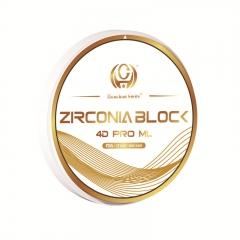 Clinical validation fully supports its outstanding performance. A prospective study published in the Journal of Dental Aesthetics in 2023 tracked 150 cases of all-zirconium crowns made of multi-layer zirconia ceramic blocks. After two years of follow-up, using the Visual Analogue Scale (VAS) for assessment, the average satisfaction score of patients with the naturalness of the restoration color was as high as 9.2 points (out of 10), which was 1.5 points higher than that of the control group using traditional single-layer zirconia. More importantly, technicians reported that the first-time fitting rate of restorations increased by nearly 20%, significantly reducing rework caused by color mismatch and shortening the average production cycle from the traditional 7 days to 5 days.
Choosing multi-layer zirconia ceramic blocks is a highly forward-looking investment. Although its unit cost may be 15% to 30% higher than that of ordinary zirconia, considering that it improves the color matching of the restoration by more than 30%, thereby significantly reducing the clinical adjustment time and the risk of patient dissatisfaction by approximately 25%, its overall return on investment is significantly positive. As a senior restoration expert pointed out: "It is not merely a piece of material, but a complete solution integrating materials science, optical principles and clinical needs, which can elevate the restoration effect from 'functional qualification' to a new height of 'aesthetic excellence'."
Clinical validation fully supports its outstanding performance. A prospective study published in the Journal of Dental Aesthetics in 2023 tracked 150 cases of all-zirconium crowns made of multi-layer zirconia ceramic blocks. After two years of follow-up, using the Visual Analogue Scale (VAS) for assessment, the average satisfaction score of patients with the naturalness of the restoration color was as high as 9.2 points (out of 10), which was 1.5 points higher than that of the control group using traditional single-layer zirconia. More importantly, technicians reported that the first-time fitting rate of restorations increased by nearly 20%, significantly reducing rework caused by color mismatch and shortening the average production cycle from the traditional 7 days to 5 days.
Choosing multi-layer zirconia ceramic blocks is a highly forward-looking investment. Although its unit cost may be 15% to 30% higher than that of ordinary zirconia, considering that it improves the color matching of the restoration by more than 30%, thereby significantly reducing the clinical adjustment time and the risk of patient dissatisfaction by approximately 25%, its overall return on investment is significantly positive. As a senior restoration expert pointed out: "It is not merely a piece of material, but a complete solution integrating materials science, optical principles and clinical needs, which can elevate the restoration effect from 'functional qualification' to a new height of 'aesthetic excellence'."
Clinical validation fully supports its outstanding performance. A prospective study published in the Journal of Dental Aesthetics in 2023 tracked 150 cases of all-zirconium crowns made of multi-layer zirconia ceramic blocks. After two years of follow-up, using the Visual Analogue Scale (VAS) for assessment, the average satisfaction score of patients with the naturalness of the restoration color was as high as 9.2 points (out of 10), which was 1.5 points higher than that of the control group using traditional single-layer zirconia. More importantly, technicians reported that the first-time fitting rate of restorations increased by nearly 20%, significantly reducing rework caused by color mismatch and shortening the average production cycle from the traditional 7 days to 5 days.
Choosing multi-layer zirconia ceramic blocks is a highly forward-looking investment. Although its unit cost may be 15% to 30% higher than that of ordinary zirconia, considering that it improves the color matching of the restoration by more than 30%, thereby significantly reducing the clinical adjustment time and the risk of patient dissatisfaction by approximately 25%, its overall return on investment is significantly positive. As a senior restoration expert pointed out: "It is not merely a piece of material, but a complete solution integrating materials science, optical principles and clinical needs, which can elevate the restoration effect from 'functional qualification' to a new height of 'aesthetic excellence'."
Çeviriniz 60 saniyede fiyatlanır, aynı gün kapınızda.
Noter tasdik, apostil ve konsolosluk onayı tek platformda. 81 dilde, 7/24.